

 Protein
 NAD+ & Longevity
 Collagen & Beauty
 Hydration & Electrolytes
 Gummies
 Cardio & Metabolic
 Vision & Eye
 Weight Management
 Pain, Joint & Recovery
 Hormonal & Vitality
 Brain & Focus
 Detox & Cleanse
 Digestive Balance
 Energy & Metabolism
 Immune Support
 Joint & Mobility
 Skin, Hair & Beauty
 Sleep & Stress
 Mood & Sleep Harmony Bundle
 Respiratory Health Bundle
 Bio-Hack Performance Bundle
 Brain Health Bundle
 Detox & Energy Bundle
 Digestion Support Bundle
 Heart & Circulation Bundle
 Immunity Support Bundle
 Liver Wellness Bundle
 Longevity & Cellular Repair Bundle
 Metabolism Support Bundle
 Mood & Sleep Harmony Bundle
 Morning Brew Bundle
 Mushroom Immunity Bundle
 Natural Detox Bundle
 Radiant Skin Bundle
 Respiratory Health Bundle
 Workout Recovery Bundle
 VitaTherx Wellness Welcome Kit


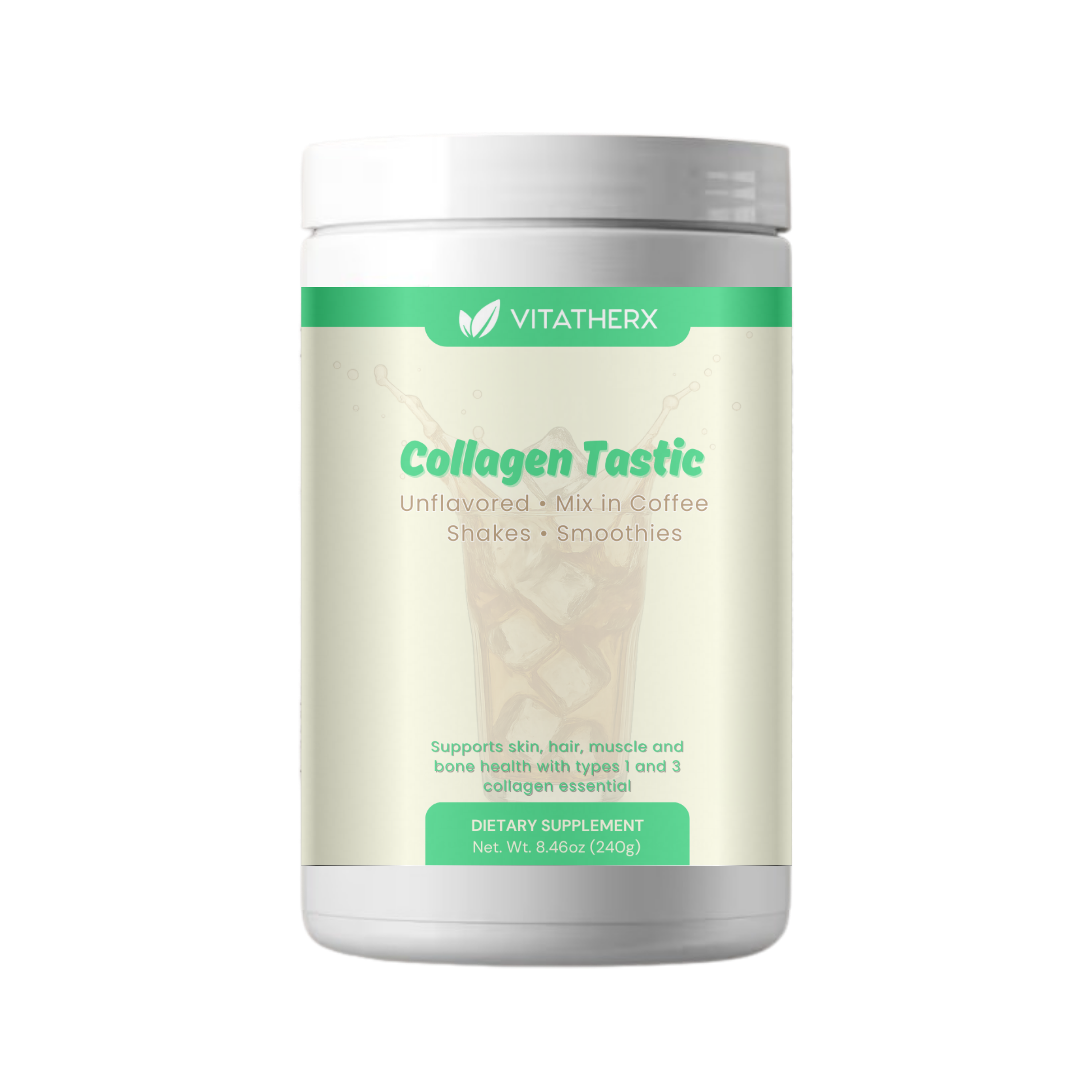








Collagen Peptides for Skin and Joints: Supported Uses and Limits
Collagen Peptides At a Glance
| Primary Focus | Skin elasticity, hydration, connective tissue support, and joint comfort |
|---|---|
| Typical Delivery | Hydrolyzed collagen peptides in powders, drinks, capsules, or multi-ingredient beauty formulas |
| Best-Supported Uses | Modest improvements in skin measures and possible support for activity-related joint discomfort |
| What Remains Unclear | Long-term durability, optimal dose, and whether all collagen products behave the same way |
| Brand Relevance | Strong fit for beauty, recovery, healthy aging, and inside-out structural support messaging |
What Collagen Peptides Are
Collagen peptides are short chains of amino acids created by hydrolyzing collagen proteins into smaller fragments that are easier to mix, digest, and absorb. Human research most often evaluates skin appearance outcomes, connective tissue support, and activity-related joint discomfort.
Takeaway: Collagen peptides are most evidence-aligned when framed as supportive nutrition for skin and joint health, not as a guaranteed reversal tool for every sign of aging.
Research Highlights
1. Skin elasticity and hydration outcomes are the strongest cosmetic evidence area
Randomized controlled studies, including Proksch et al. and Choi et al., report improvements in skin elasticity and related dermal measures after several weeks of supplementation.
Meaning: The aesthetic evidence is promising, especially for elasticity and hydration-style outcomes, but results vary by formula and study design.
2. Joint discomfort support is plausible, especially in active populations
A 24-week athlete study by Clark et al. reported improvements in activity-related joint pain measures with collagen hydrolysate supplementation.
Meaning: Collagen may be useful as part of a recovery or structural-support routine, particularly where repeated joint loading is a concern.
3. Reviews support promise, but product heterogeneity is a major limitation
Systematic reviews such as Khatri et al. and broader reviews such as Al-Atif conclude that the evidence is promising but heterogeneous.
Meaning: It is not scientifically clean to assume that every collagen product, source, and dose will deliver the same effect.
Where the Evidence Is Strongest
- Modest benefits for skin elasticity, hydration, and wrinkle-related appearance measures.
- Possible support for joint comfort and recovery in active individuals.
- Good fit for stacked beauty-and-structure positioning when claims remain measured.
Where Claims Need More Caution
- Collagen is not a proven cure for osteoarthritis or all joint disease states.
- Not all collagen forms, doses, and co-ingredient systems are interchangeable.
- Some study endpoints are cosmetic or subjective rather than hard clinical outcomes.
How to Read a Collagen Product More Critically
Look for the peptide form, serving size, whether the product is hydrolyzed, and whether the brand is making appearance-support claims or stronger medical-sounding promises. The strongest claim-safe angle is support for skin and connective tissue health over time.
Frequently Asked Questions
References
- Khatri M, et al. The effects of collagen peptide supplementation on body composition, collagen synthesis, and recovery. Amino Acids (2021).
- Al-Atif H. Collagen Supplements for Aging and Wrinkles. Dermatology Practical & Conceptual (2022).
- Proksch E, et al. Oral supplementation of specific collagen peptides has beneficial effects on human skin physiology. Skin Pharmacology and Physiology (2014).
- Choi SY, et al. Effects of collagen tripeptide supplement on skin properties. Journal of Cosmetic and Laser Therapy (2014).
- Addor FAS, et al. Improvement of dermal parameters in aged skin after oral use of a nutrient supplement. Clinical, Cosmetic and Investigational Dermatology (2018).
- Clark KL, et al. 24-Week study on the use of collagen hydrolysate in athletes with activity-related joint pain. Current Medical Research and Opinion (2008).
- Choosing a selection results in a full page refresh.
- Opens in a new window.