

 Protein
 NAD+ & Longevity
 Collagen & Beauty
 Hydration & Electrolytes
 Gummies
 Cardio & Metabolic
 Vision & Eye
 Weight Management
 Pain, Joint & Recovery
 Hormonal & Vitality
 Brain & Focus
 Detox & Cleanse
 Digestive Balance
 Energy & Metabolism
 Immune Support
 Joint & Mobility
 Skin, Hair & Beauty
 Sleep & Stress
 Mood & Sleep Harmony Bundle
 Respiratory Health Bundle
 Bio-Hack Performance Bundle
 Brain Health Bundle
 Detox & Energy Bundle
 Digestion Support Bundle
 Heart & Circulation Bundle
 Immunity Support Bundle
 Liver Wellness Bundle
 Longevity & Cellular Repair Bundle
 Metabolism Support Bundle
 Mood & Sleep Harmony Bundle
 Morning Brew Bundle
 Mushroom Immunity Bundle
 Natural Detox Bundle
 Radiant Skin Bundle
 Respiratory Health Bundle
 Workout Recovery Bundle
 VitaTherx Wellness Welcome Kit


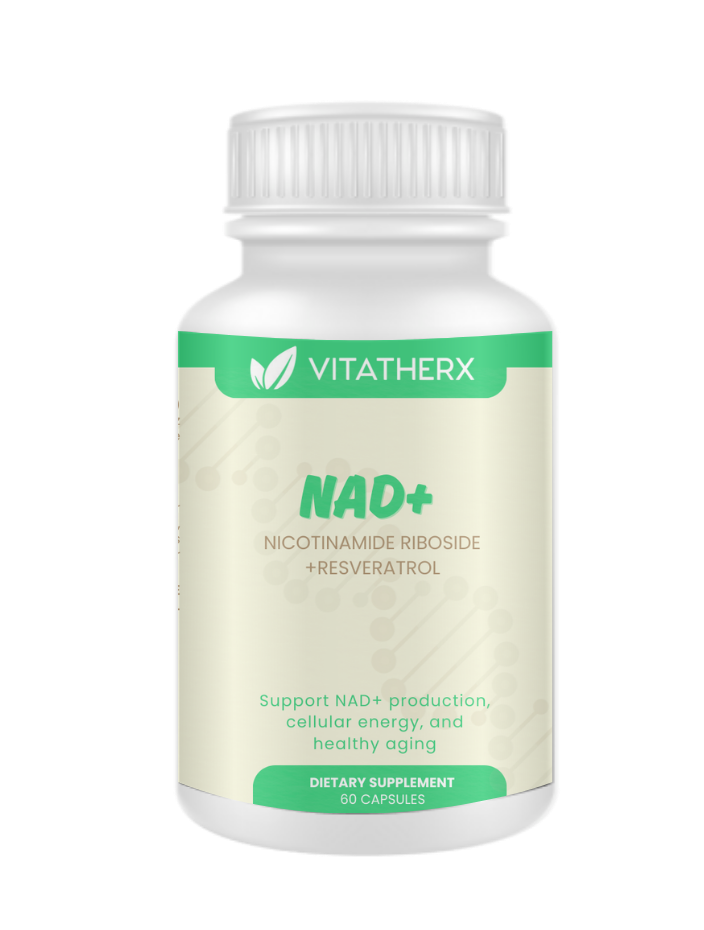







NAD+ and Nicotinamide Riboside: What Human Studies Actually Show
NAD+ At a Glance
| Primary Focus | Cellular energy metabolism, mitochondrial function, and healthy aging research |
|---|---|
| Common Companion Ingredient | Nicotinamide riboside (NR), an NAD+ precursor used in human studies |
| What Human Trials Show Best | Reliable increases in blood NAD+ metabolites and good short-term tolerability |
| What Remains Unclear | Whether higher NAD+ levels consistently translate into major clinical benefits in healthy adults |
| Brand Relevance | Useful for longevity, energy, recovery, and healthy aging positioning when claims stay evidence-aligned |
What NAD+ Is and Why It Matters
NAD+ is a coenzyme involved in redox reactions, mitochondrial energy production, DNA repair signaling, and cellular stress responses. Because natural NAD+ levels decline with age and metabolic stress, researchers have explored whether NAD+-supporting compounds can improve healthspan-related outcomes.
Most commercial products do not deliver NAD+ directly into tissues in a clinically proven way. Instead, human research most often focuses on precursors such as nicotinamide riboside, which can raise circulating NAD+ metabolites after oral use.
Takeaway: The strongest human evidence today supports NAD+ precursor bioavailability and safety more than dramatic anti-aging or performance outcomes.
Research Highlights
1. Oral NR can raise NAD+ metabolites in humans
In an early translational study, Trammell et al. showed that oral nicotinamide riboside is bioavailable in humans and significantly increases NAD+ metabolite levels in blood.
Why it matters: This is the foundation for most modern NAD+ supplement positioning. If a precursor does not measurably raise NAD+ metabolites, the rest of the value story becomes weak.
2. Midlife and older adult trials support tolerability and biomarker lift
A placebo-controlled trial in healthy middle-aged and older adults found that chronic NR supplementation was well tolerated and increased whole-blood NAD+. This helps support the ingredient's legitimacy as a measurable metabolic intervention.
What it does not prove: Raising NAD+ biomarkers is not the same as proving broad anti-aging effects, cognitive enhancement, or disease prevention.
3. Safety data are encouraging, but outcome claims still need restraint
Longer-duration safety work, including Conze et al., supports good tolerability across studied dosing ranges. Reviews such as Mehmel et al. and Blanco-Vaca et al. note that human cardiometabolic and aging-related results remain mixed or preliminary.
Bottom line: NAD+ support is scientifically interesting and mechanistically credible, but the evidence base is still evolving when it comes to hard clinical outcomes.
Where the Evidence Is Strongest
- NR raises NAD+ metabolites in blood and is orally bioavailable.
- Short- and medium-term studies suggest good tolerability in adults.
- Mechanistic rationale for cellular energy and healthy aging research is strong.
Where Claims Need More Caution
- Human trials do not yet prove that NAD+ supplements reverse aging.
- Evidence for large benefits in weight loss, insulin sensitivity, or athletic performance is inconsistent.
- Many impressive claims still rely on preclinical models rather than definitive human endpoints.
How to Read an NAD+ Product More Critically
Look for clarity on the actual active ingredient, dose, precursor form, and whether the brand is describing biomarker effects or real clinical outcomes. Evidence-backed language should focus on NAD+ metabolism support, healthy cellular energy, and tolerability rather than promising sweeping age-reversal outcomes.
Frequently Asked Questions
References
- Rajman L, Chwalek K, Sinclair DA. Therapeutic Potential of NAD-Boosting Molecules: The In Vivo Evidence. Cell Metabolism (2018).
- Blanco-Vaca F, et al. NAD+-Increasing Strategies to Improve Cardiometabolic Health? Frontiers in Endocrinology (2022).
- Mehmel M, et al. Nicotinamide Riboside-The Current State of Research and Therapeutic Uses. Nutrients (2020).
- Trammell SAJ, et al. Nicotinamide riboside is uniquely and orally bioavailable in mice and humans. Nature Communications (2016).
- Martens CR, et al. Chronic nicotinamide riboside supplementation is well-tolerated and elevates NAD+ in healthy middle-aged and older adults. Nature Communications (2018).
- Conze D, et al. Safety and Metabolism of Long-term Administration of NIAGEN (Nicotinamide Riboside Chloride). Scientific Reports (2019).
- Dollerup OL, et al. A randomized placebo-controlled clinical trial of nicotinamide riboside in obese men. American Journal of Clinical Nutrition (2018).
- Choosing a selection results in a full page refresh.
- Opens in a new window.